Your confirmation method has to hold up in two places: on the instrument at 2 a.m., and in front of an inspector who has seen every shortcut. I develop and validate LC-MS/MS toxicology methods on site, at the instrument, alongside your analysts. Your Laboratory Director gets a validation package that answers the hard questions before anyone asks them.
Toxicology LC-MS/MS Method Validation, Built at the Instrument

Where toxicology validations go wrong
Most tox validations that fail don't fail on the calibration curve. They fail on what the curve doesn't show.
Ion suppression measured in one lot of blank urine, then assumed for every patient.
Isobaric pairs such as morphine and hydromorphone, or codeine and hydrocodone, with no demonstrated chromatographic separation.
Glucuronide hydrolysis assumed complete because the enzyme insert said so.
Ion ratio and retention time windows set after the data came in, not before.
Stability claims that don't match how specimens actually sit on your bench, in your refrigerator, and in your autosampler.
A package that reads as complete until someone asks for the raw data behind one summary table.
The vendor's application scientist leaves after the install. The method stays. So do the findings. If any of this sounds familiar, the method may still be sound. The evidence just isn't there yet.

What CLIA requires, and what a defensible tox validation covers
LC-MS/MS confirmation methods are laboratory-developed tests. Under 42 CFR 493.1253(b)(2), a lab must establish accuracy, precision, analytical sensitivity, analytical specificity including interfering substances, reportable range, and reference intervals before reporting patient results. CAP-accredited labs also answer to the Chemistry and Toxicology checklist. CLSI C62 is the LC-MS guideline inspectors expect a method to reflect.
For a toxicology method, that becomes a set of studies like these:
Calibration model and weighting: the curve fits where decisions are made, at the cutoff and the LLOQ, not just across the middle.
Accuracy and bias: results agree with independently sourced reference material and with split specimens from your reference lab.
Precision: within-run and between-day reproducibility at low, cutoff and high concentrations.
LLOQ and cutoff performance: positives and negatives are called correctly near the decision point.
Matrix effects: ion suppression and enhancement measured across multiple independent donor lots.
Selectivity and interference: isobars, isomers, metabolites and common co-medications don't produce false results.
Hydrolysis efficiency: conjugated drugs are actually freed before you report a total concentration.
Identification criteria: ion ratio and retention time tolerances written down before the study, then applied.
Carryover and dilution integrity: a high specimen can't contaminate the next one, and diluted results stay accurate.
Stability: specimens and extracts hold up under your real handling conditions.

How I work: at the instrument, with your team
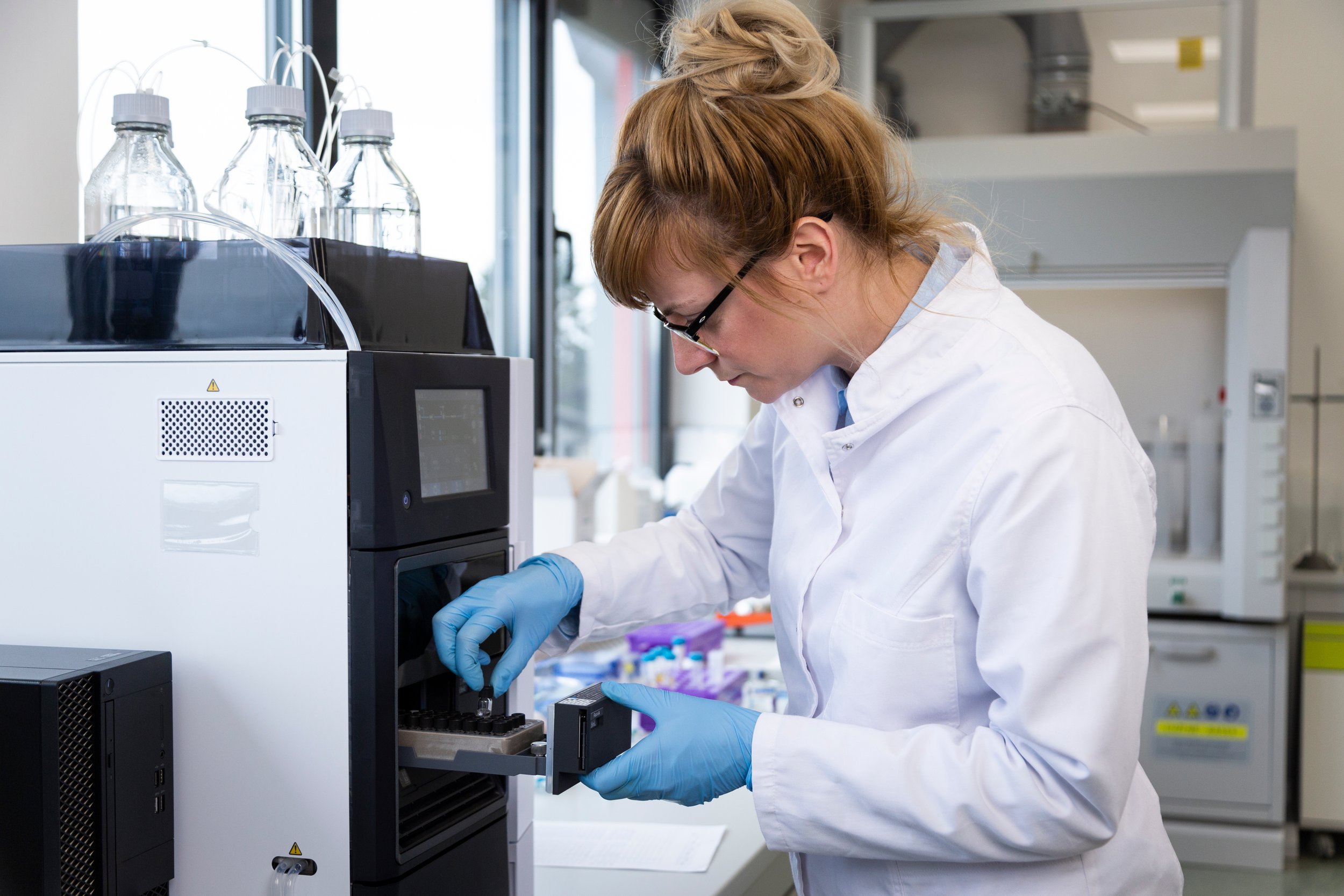
A protocol handed to a lab and left for its staff to run is the cheapest version of this work. It is also the version that comes back as findings. I work at the instrument with your analysts, from scope to signed report.
Scope review. We confirm whether each method needs verification or full validation, and document why.
Method optimization. Chromatography, transitions, internal standards and extraction, tuned on your platform in your matrix.
Validation plan. Acceptance criteria written and approved before the first study injection.
Studies run on site. I run the studies alongside your analysts, so the people who will own the method learn it while it is being proven.
Report and SOP. A package your Laboratory Director reviews and signs, with raw data traceable from every summary table.
Handoff. Analyst training records, a QC strategy carried forward from the validation data, and defined revalidation triggers.
Who this is for
Physician practices and pain management or urology groups bringing confirmation testing in-house
Toxicology labs adding analytes to an existing panel, such as fentanyl analogs, xylazine or nitazenes
Labs adding oral fluid or blood to an established urine method
Labs moving a method to a new instrument or a second site
Labs answering an inspection finding on validation
Labs whose validation stalled when the person running it left

When a validation stalls mid-project
Staff turnover doesn't move a launch date. If your lab manager or lead analyst left partway through a validation, I review what was completed, keep the data that holds up, and finish the rest. You avoid starting over, and you don't carry a half-documented method into an inspection.
Why labs work with me
15+ years of laboratory experience, with senior leadership of regulated laboratories since 2015, including CLIA high-complexity clinical operations and ISO 17025 accredited laboratories
Former LC/MS Program Manager and Field Application Specialist, so I know these instruments from the vendor side and the lab side
Former Scientific and Laboratory Director at BelCosta Labs, and Chief Laboratory Officer at MMR Services
M.S. in Biology, with an emphasis in Microbiology and Molecular Biology
Expert witness experience. I build documentation expecting it to be read by someone looking for the weak point.
No financial ties to instrument manufacturers, so platform advice isn't tied to anyone's next sale
Platforms: Sciex Triple Quad and QTRAP systems from the API 3000 through the 7500+, Shimadzu LCMS-8040 through the current RX series and LCMS-8065XE, and Agilent LC/TQ systems from the 6460 through the 6495D
Inspectors don't grade effort. They grade evidence.
Toxicology LC-MS/MS validation:
Common Questions
What does CLIA require to validate an LC-MS/MS toxicology test?
An LC-MS/MS method built by the lab is a laboratory-developed test. Under 42 CFR 493.1253(b)(2), the lab must establish accuracy, precision, analytical sensitivity, analytical specificity including interfering substances, reportable range, and reference intervals before reporting patient results. For toxicology, that also means matrix effects, isobar separation, hydrolysis efficiency, carryover and stability, documented in line with CLSI C62 and any CAP checklist requirements that apply.
Does my toxicology method need verification or full validation?
Verification applies to an unmodified FDA-cleared test. Most LC-MS/MS confirmation methods are lab-developed, so they need full validation. A cleared method also needs validation once it is modified: a new specimen type, a different extraction, a changed cutoff or a new instrument can each move it from verification to validation. Documenting that decision is part of a defensible package.
How long does a toxicology LC-MS/MS validation take?
It depends on panel size, how far along the method is, and how fast specimens and reference materials can be sourced. Stability studies usually set the calendar more than instrument time does.
Do you work on site?
Yes. Method optimization and the validation studies happen on site, at the instrument, alongside your analysts. Planning, data review and report writing run remotely between visits.
Which LC-MS/MS platforms do you work on?
Sciex Triple Quad and QTRAP systems from the API 3000 through the 7500+, Shimadzu LCMS-8040 through the current RX series and LCMS-8065XE, and Agilent LC/TQ systems from the 6460 through the 6495D. Validation principles are the same on every platform. Tuning and troubleshooting are not, which is why platform experience matters.
Can you finish a validation someone else started?
Yes. I review the plan, data and documentation already in place, keep what holds up, and redo only what doesn't. That is usually faster than starting over, and it keeps an incomplete method out of an inspection.
What's included in the validation package?
A validation plan with acceptance criteria set in advance, the raw data, a summary report, the method SOP, analyst training records, and a QC strategy drawn from the validation data. Your Laboratory Director reviews and signs it. Every summary table traces back to raw data.
Do you also validate the immunoassay screen and specimen validity tests?
Yes. Screening cross-reactivity and specimen validity tests such as creatinine, pH, specific gravity and oxidants need their own verification or validation, documented alongside the confirmation method.
Talk through your method
Tell me where the method stands: the panel, the platform, and what has been done so far. If it's further along than you think, I'll say so. If it isn't, you'll know what's missing before an inspector does.
Would it be ridiculous to put twenty minutes on the calendar?
Written by Ron Brooks, M.S. · Last updated November 24, 2026